
Can 60 GHz signals for 5G steal oxygen from the air? No—they cannot. Oxygen molecules do absorb 60 GHz signals more efficiently than lower-frequency radio waves, but this only converts a tiny fraction of the signal’s energy into heat in the air. The oxygen itself remains chemically unchanged, so your ability to breathe is unaffected. Engineers also use this property to reduce interference in short-range, high-speed wireless systems.
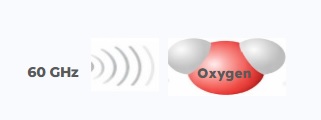
Illustration of a 60 GHz electromagnetic wave interacting with an oxygen (O2) molecule, demonstrating microwave absorption characteristics relevant to atmospheric physics and communication technologies.
Image: Created by EMFSA using free vector elements from https://pixabay.com/
Minor note: The absorption at 60 GHz is particularly strong due to molecular resonance. This property makes the band ideal for engineered short-range links but unsuitable for long-haul communication, which is why it’s mainly used in dense urban areas or to connect specific points rather than for broad coverage.
Real-World Applications of 60 GHz (V-Band) Technology:
60 GHz signals are already used in homes, offices, and public spaces worldwide. Beyond ultra-fast Wi-Fi, this frequency band is actively used for high-capacity, short-range wireless communication.
Examples of 60 GHz Use
- Ultra-fast WiGig Wi-Fi for wireless docking and VR systems
- Indoor and campus wireless links for offices, universities, and data centers
- Point-to-point (PTP) connections for building-to-building links
60 GHz Technology in South Africa
In South Africa, 60 GHz technology is widely used as a faster, cost-effective alternative to laying fibre optic cables. Internet service providers, businesses, and public infrastructure projects deploy it mainly in dense urban areas or to connect remote locations where fibre installation is challenging.
Key applications include:
- High-Capacity Point-to-Point (PTP) Links: Connecting buildings, typically up to about 1.5 km
- Small Cell Backhaul: Linking mobile network infrastructure in cities
- ISP Last-Mile Connectivity (Fixed Wireless Access) that delivers high-speed internet where fibre is not available
- Campus Networks: High-speed connections across schools, business parks, and retail centres
- Security and Video Surveillance: Supporting high-capacity video transmission
The Independent Communications Authority of South Africa (ICASA) allows the use of this band (typically 57–66 GHz), aligning with international standards. One advantage of 60 GHz is that it allows many links to operate in a small area with minimal interference.
Satellite Megaconstellations and 60 GHz
Satellite megaconstellations such as Starlink, OneWeb, and Amazon Kuiper do not use 60 GHz for consumer connections. These systems operate primarily in lower frequency bands, such as the Ku and Ka bands, which can travel long distances from space to Earth.
The 60 GHz band is only practical for short-range, ground-based links. This means the oxygen absorption discussed here applies only to local wireless systems—not satellites—and does not affect the air we breathe.
Why Oxygen Absorbs 60 GHz Signals
At around 60 GHz, oxygen molecules have a natural resonance that makes them more likely to take in energy from radio waves. Importantly, this is a normal and harmless physical process.
What actually happens?
- Energy absorption is temporary – oxygen molecules take in a tiny amount of energy and release it as heat
- No chemical change occurs – the oxygen molecules remain the same
- Signals weaken over distance – this is why 60 GHz is used for short-range communication
- Engineers use this effect – it helps reduce interference and improves performance in dense areas
Looking Ahead: Higher Frequencies and Future Networks
Scientific research shows that interactions between radio waves and living organisms are frequency-dependent. For example, a recent study on fruit flies (Drosophila melanogaster) exposed to radio-frequency fields found no effects on behaviour or reproduction, even at levels higher than typically encountered in real environments.
Modelling from the same research suggests that much higher frequencies (around 90 GHz)—which may be used in future technologies—could result in greater energy absorption in very small organisms like insects.
However, this refers to tiny, localized effects and does not imply any risk to humans or oxygen in the air.
Citation:
De Boose, P., Ribas, F. O., Bell, D., Bouga, M., De Borre, E., Fröhlich, J., et al. (2025). Behaviour and reproduction of Drosophila melanogaster exposed to 3.6 GHz radio-frequency electromagnetic fields.PLOS ONE, 20(12), e0336228.
Closing Thoughts: Can 60 GHz Signals for 5G Steal Oxygen from the Air?
The idea that 60 GHz signals for 5G could “steal” oxygen comes from a misunderstanding of how radio waves interact with the atmosphere. While 60 GHz is absorbed by oxygen at a higher rate than other radio frequencies, this is a well-known and harmless effect that only reduces signal strength over distance. The energy deposited in the air is minimal and does not affect oxygen availability or human breathing. Engineers even take advantage of oxygen’s absorption characteristics to design efficient, high-speed, short-range wireless systems, while long-distance communication continues to rely on lower-frequency bands that propagate further without excessive attenuation.
Further reading (2021):
Does Amazon’s Sleep Tracking Technology Invade Bedroom Privacy? Concerns Raised About Data Sharing, Opacity of Intentions for Collected Information https://www.emfsa.co.za/news/does-amazons-sleep-tracking-technology-invade-bedroom-privacy-concerns-raised-about-data-sharing-opacity-of-intentions-for-collected-information/
References
- MCToon.net. (n.d.). 60 GHz does get absorbed by oxygen at a much higher rate than other frequencies of radio waves. Retrieved March 22, 2026, from https://mctoon.net/60ghz/
- ICO Optics. (n.d.). Atmospheric layers and their effect on radio propagation.Retrieved March 22, 2026, from https://www.ico-optics.org/atmospheric-layers-and-their-effect-on-radio-propagation/
- De Boose, P., Ribas, F. O., Bell, D., Bouga, M., De Borre, E., Fröhlich, J., et al. (2025). Behaviour and reproduction of Drosophila melanogasterexposed to 3.6 GHz radio-frequency electromagnetic fields. PLOS ONE, 20(12), e0336228. https://doi.org/10.1371/journal.pone.0336228
- Independent Communications Authority of South Africa (ICASA). (n.d.). Radio spectrum standards and regulations.Retrieved March 22, 2026, from https://www.icasa.org.za
- IEEE. (2012). IEEE Standard 802.11ad-2012. https://standards.ieee.org/standard/802_11ad-2012.html
- IEEE. (2021). IEEE Standard 802.11ay-2021. https://standards.ieee.org/standard/802_11ay-2021.html