Living Near High-Voltage Power Lines: What Does the New Research Tell Us?
Living very close to major high-voltage transmission lines is something we would investigate carefully before purchasing a property.
EMFSA | 14 September 2026
In this article, we look at:
- the type of EMF produced by high-voltage transmission lines;
- what the research tells us about possible health effects;
- new evidence concerning dementia;
- induced voltages, RF phenomena and audible noise;
- factors that could change exposure in the future; and
- practical property issues such as servitudes and resale considerations.
For a prospective homeowner, these issues raise several practical questions. What are the electromagnetic-field levels at the property? What does current research tell us about potential health effects? Could exposure change over time? And what other factors, such as transmission servitudes or future changes to the electricity network, could affect the property?
What type of EMF are we concerned about?
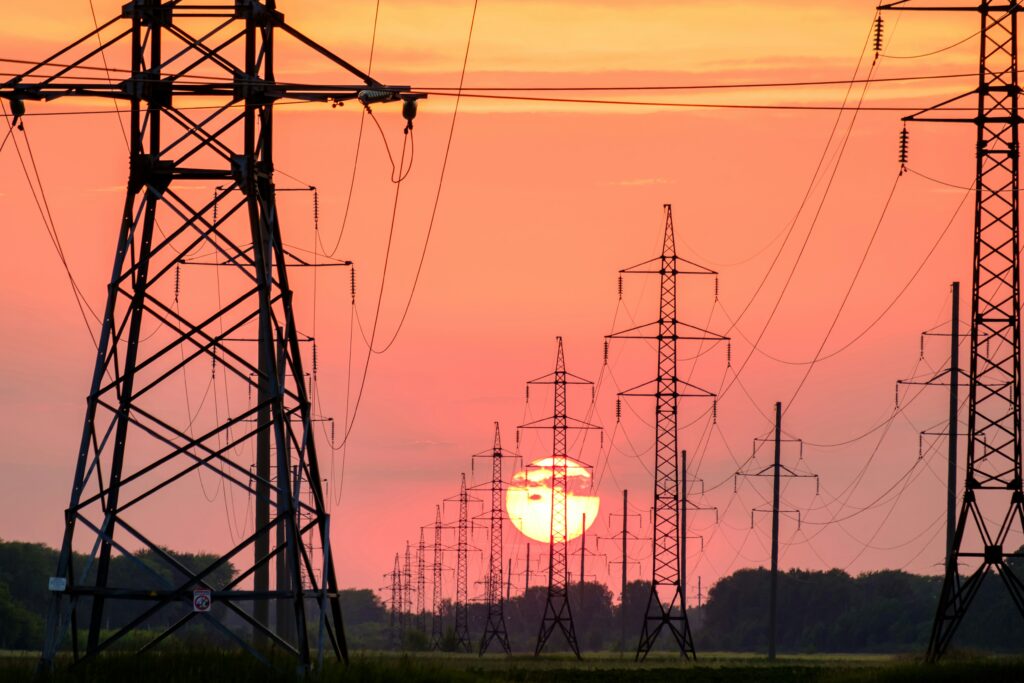
From an electromagnetic-field perspective, one of the principal considerations associated with high-voltage transmission lines is extremely low-frequency (ELF) magnetic fields, typically at the electricity supply frequency of 50 Hz in South Africa.
The electrical current flowing through the conductors produces the magnetic field. Unlike the electric field, which buildings and other structures can substantially affect, magnetic fields at these frequencies can pass through most common building materials with relatively little attenuation.
The strength of the magnetic field generally decreases as distance from the conductors increases. However, distance alone does not tell us what the exposure will be inside a particular property.
Current flowing through the transmission line varies according to electricity demand and other factors. Consequently, magnetic-field levels can vary over time. The configuration and height of the conductors, the number of circuits, the loading of the line and the position of the property relative to the conductors can all influence the resulting field.
Why 50 Hz?
South Africa’s electricity supply system operates at a nominal frequency of 50 Hz. Eskom states that its generators synchronise with the National Grid at 50 Hz and that its transmission network operates at several voltage levels, including 132 kV, 275 kV, 400 kV and 765 kV.[1]
This is why the electromagnetic-field assessment of a property close to a high-voltage transmission line focuses particularly on 50 Hz extremely low-frequency (ELF) electric and magnetic fields.
The 50 Hz refers to the frequency of the alternating current: the electrical waveform completes approximately 50 cycles per second. It does not indicate the voltage of the transmission line.
The alternating current produces the associated magnetic field, while the voltage between the conductors and ground produces an electric field. The strength of these fields at a particular property depends on a number of factors, including the line voltage, current, conductor configuration, height and geometry of the transmission line, and the property’s distance and position relative to the conductors.
What about induced voltages and radio-frequency interference?
A property close to a high-voltage transmission line can also experience electromagnetic coupling to nearby conductive structures. This is different from simply measuring the 50 Hz magnetic field in the environment.
A changing magnetic field can induce voltages and currents in nearby conductive circuits, while the electric field surrounding an energized transmission line can capacitively couple to isolated or poorly grounded metal structures. Depending on the geometry and electrical configuration, this can affect conductive structures such as fences, cables, pipes and other metal installations. Both inductive and capacitive coupling are well-established engineering phenomena.[2]
Electric fences: one example, particularly from an electrical-safety perspective
Research has specifically examined capacitive and inductive coupling between high-voltage power lines and electric-fence wires. In one recent study, the authors calculated induced voltages under a range of power-line and fence configurations and found that, for typical fence placements, the induced voltages were less than 15 V. They also recommended temporarily grounding fence lines during installation work.[3]
Large metal structures, including metal roofing
Large metal structures should not automatically be assumed to be electrically isolated from their surroundings. Whether a particular structure develops a measurable induced voltage depends on its geometry, proximity to the transmission line, grounding and bonding arrangements, and the electrical characteristics of the surrounding system.
Radio-frequency interference
High-voltage transmission lines and associated equipment can also produce radio-frequency interference (RFI). Corona discharge and other electrical phenomena associated with high-voltage equipment can generate electromagnetic interference over a range of radio frequencies.[4]
This is not the same as saying that a transmission line functions as a radio-frequency transmitter. RFI refers to unintended electromagnetic energy that can interfere with radio communications or electronic equipment. In some transmission systems, however, utilities also deliberately use radio-frequency signals on power conductors for communication, protection or control. These are known as power-line carrier systems.
These RF phenomena are distinct from the 50 Hz fields produced by the fundamental power-frequency current and voltage. They should therefore not be confused with the ordinary 50 Hz electric and magnetic fields associated with electricity transmission.
Different measurements answer different questions. A 50 Hz magnetic-field measurement does not, for example, determine whether an isolated metal structure has an induced voltage, nor does it characterise radio-frequency interference.
Consequently, where a property is immediately adjacent to a major transmission corridor, an assessment may need to consider more than simply the 50 Hz magnetic field. Depending on the site, it may be appropriate to investigate 50 Hz electric and magnetic fields, induced voltages on significant conductive structures, grounding and bonding arrangements, and, where there is a specific reason to do so, radio-frequency interference or other RF phenomena associated with the transmission infrastructure.
What does health research tell us?
The principal longstanding epidemiological concern regarding ELF magnetic fields has been childhood leukaemia.
Some epidemiological studies have reported an association between childhood leukaemia and long-term residential exposure to ELF magnetic fields in the region of approximately 0.3–0.4 µT and above.[5] However, this should not be interpreted as a proven biological threshold at which childhood leukaemia begins to occur.
It is also important to distinguish between studies that estimate exposure using distance from power lines and those that directly measure or model magnetic-field exposure. Distance is an imperfect proxy for magnetic-field exposure because field strength depends on factors such as line configuration and current loading. Some studies have reported associations with proximity that are not clearly explained by ELF magnetic-field exposure alone.[5]
The evidence has not established a causal relationship. The International Agency for Research on Cancer (IARC) classified ELF magnetic fields as Group 2B, “possibly carcinogenic to humans,” based principally on the limited epidemiological evidence concerning childhood leukaemia.[6]
This classification does not mean that ELF magnetic fields have been demonstrated to cause childhood leukaemia. It reflects the level of evidence available to IARC at the time of its evaluation. IARC’s 2002 evaluation specifically concluded that there was limited evidence in humans for the carcinogenicity of ELF magnetic fields in relation to childhood leukaemia, while evidence for other cancers was inadequate.[6]
New research: dementia mortality and high-voltage power lines
There is now another area of research worth following.
A very large nationwide Swiss cohort study published in 2026 investigated long-term residential exposure to magnetic fields from high-voltage power lines and mortality from several neurodegenerative diseases.[7]
The researchers followed 3,555,064 adults between 2001 and 2018, contributing approximately 55.4 million person-years of observation. They modelled long-term ELF magnetic-field exposure from high-voltage power lines using proximity-based exposure models and updated the models over several time periods.[7]
The researchers reported an association between estimated long-term exposure to magnetic fields from high-voltage power lines and mortality from Alzheimer’s disease and other dementias. They did not find corresponding associations for amyotrophic lateral sclerosis (ALS), Parkinson’s disease or multiple sclerosis.[7]
This is an interesting finding because of the size and duration of the study. However, it is important not to overinterpret the result.
The study was observational. An observational association does not establish that exposure to the magnetic field caused the disease.
The authors concluded that causal inference remains limited, including because an established biological mechanism has not been demonstrated.[7]
The appropriate conclusion is therefore that the study adds new epidemiological evidence that warrants further investigation, rather than demonstrating that living near a high-voltage power line causes dementia.
What does the broader evidence show?
A 2026 scoping review examined human and experimental research relating specifically to ELF-EMF exposure from high-voltage transmission lines and substations.[8]
The review mapped 51 primary empirical studies published between 1979 and 2025. It illustrates how broad and heterogeneous the research is. Different studies have examined different health outcomes, exposure levels, populations and methodologies.
This is important because the question is not simply whether any study has reported an association. The strength and consistency of the evidence, the quality of exposure assessment, possible confounding factors, biological plausibility and the ability of other researchers to reproduce findings all matter when assessing whether an association represents a causal relationship.
The review identified childhood leukaemia as the most frequently studied outcome, while evidence concerning neurodegenerative diseases was much more limited. The authors described the evidence concerning Alzheimer’s disease as suggestive but noted that evidence for other neurodegenerative outcomes remained insufficient.[8] Because this was a scoping review, the authors did not formally assess the quality or risk of bias of individual studies; the review was intended to map the available research rather than determine the strength or reliability of the reported associations.
Why actual measurement matters
For an individual property, we would not rely simply on the distance from the nearest pylon or transmission line.
A property that appears relatively close to a transmission line may have lower magnetic-field levels than expected, while another property at a greater distance may have higher levels depending on the configuration and loading of the line.
We would therefore recommend measuring the 50 Hz magnetic fields at the actual property, particularly in bedrooms and other areas where people spend substantial amounts of time.
A single measurement, however, provides only a snapshot.
Because the current flowing through a transmission line varies, magnetic-field levels can also vary during the day and over longer periods. Where the result is important to a purchasing decision, measurements at different times or longer-term monitoring may provide a more representative picture of the exposure.
It is also important to recognise that a magnetic-field measurement cannot, by itself, determine induced voltages on nearby conductive structures or characterise RF interference. Those questions require appropriate measurements or engineering assessment.
At present, the evidence does not establish that ELF magnetic-field exposure from high-voltage transmission lines causes dementia or other neurodegenerative diseases.
The same caution applies to the longstanding childhood-leukaemia findings: the epidemiological association remains an important unresolved issue, but causation has not been established.
Building Biology Guidelines
In our property assessments, we may also interpret measurements in relation to the Building Biology Guidelines, which provide precautionary reference levels intended for living and sleeping environments.
These values are generally considerably more precautionary than regulatory or public-exposure reference levels.
It is important to understand what this means — and what it does not mean.
Exceeding a Building Biology reference value does not establish that a health effect will occur, nor does it demonstrate that a property is unsafe. These are precautionary reference values rather than scientifically established disease thresholds.
Their purpose is to provide a more precautionary framework for evaluating exposure in environments where people live and sleep.
We have measured properties and areas where 50 Hz magnetic-field levels exceeded the Building Biology reference values. This is one reason we prefer to assess the actual exposure at a property, rather than making assumptions based solely on distance from a transmission line.
Could the exposure change in the future?
There is another consideration that is sometimes overlooked when purchasing a property close to a major transmission corridor.
The present magnetic-field level is not necessarily the level that will exist throughout the lifetime of the property.
Transmission lines can operate at different loading levels depending on electricity demand and network conditions. Transmission infrastructure may also be upgraded, reinforced or modified.
Because magnetic-field strength is related to the current flowing through the conductors, increased loading can result in higher magnetic-field levels.
For this reason, where appropriate, we would recommend finding out whether there are any known or proposed changes affecting the particular transmission corridor, such as:
- upgrading or uprating of the line;
- reconductoring;
- additional circuits;
- changes to transmission capacity; or
- other planned infrastructure developments.
When purchasing a property, it may be worthwhile obtaining information directly from the relevant electricity transmission authority rather than assuming that the present configuration will remain unchanged indefinitely.
Audible noise from transmission lines
There is also a practical consideration that is separate from the health evidence concerning ELF magnetic fields: audible noise from the transmission line.
High-voltage transmission lines can produce audible noise as a result of corona discharge around the conductors. Depending on the characteristics of the line and the conditions, this may be perceived as a low-frequency hum, crackling, hissing or similar sounds. Corona discharge is an important source of audible noise from high-voltage overhead transmission lines.
The level of audible noise can be affected by factors including conductor design, conductor surface condition, electric-field intensity at the conductor surface and weather conditions. Noise can be more pronounced under particular wet-weather conditions and, depending on the line and environment, may also be significant under dry conditions.
This is not simply a theoretical consideration in the South African context. A 2026 CIGRE publication specifically examining South Africa’s 765 kV transmission network discusses audible-noise performance in relation to conductor design, corona activity, altitude and wet and dry weather conditions.[9]
For a prospective purchaser, this is another reason why a property should ideally not be assessed only during one short site visit under favourable weather conditions. If a transmission line is very close to the property, it may be useful to visit the site under different weather conditions and, where appropriate, consider an acoustic assessment.
It is important to distinguish this established physical phenomenon from the separate corona-ion hypothesis sometimes discussed in relation to possible health effects. The fact that corona discharge can produce audible noise does not, in itself, demonstrate that corona ions cause adverse health effects.
Corona ions: another proposed concern
The corona phenomenon also gives rise to another, quite different question: whether corona ions could have health effects.
High-voltage transmission lines can produce corona ions, particularly under certain weather conditions.
A hypothesis has been proposed that these ions could interact with airborne pollutants and potentially influence health. Research has investigated this possibility, including in relation to childhood cancer.[10]
However, epidemiological research has not provided evidence supporting the corona-ion hypothesis as an explanation for the observed childhood leukaemia pattern near high-voltage power lines. In a 2014 study, Swanson et al. found that their corona-ion exposure model explained the observed pattern less well than straightforward distance from power lines. The authors concluded that their findings did not support the hypothesis, although they noted that the study did not definitively disprove it.[10]
The corona-ion hypothesis therefore remains unestablished and should not be presented as a demonstrated health effect.
We would not treat the corona-ion hypothesis in the same way as the more extensively studied question of ELF magnetic-field exposure.
Property value and resale considerations
There is also a non-health consideration.
Properties immediately adjacent to major transmission lines may have a smaller pool of prospective buyers. In some circumstances this can affect market value or the time required to sell a property.
However, this varies considerably according to location, property type, visual impact, buyer preferences and the local property market.
We would therefore not recommend assuming a particular percentage reduction in property value simply because a property is near a transmission line.
If this is an important consideration, an independent property valuer can assess comparable properties and local sales data.
Check the transmission servitude
Investigate the transmission servitude carefully before purchasing.
A servitude gives the holder specified rights over another person’s land for a particular purpose. Eskom’s documentation explains that a servitude is registered in the Deeds Office against the property’s title and gives Eskom specified rights in relation to the electricity infrastructure.[11]
The estate agent may be able to provide information, but we would recommend having the conveyancer verify the position and conditions of the registered servitude against the title deed and the relevant servitude documentation. The precise legal effect of a servitude depends on the registered instrument and the circumstances of the property.
For a prospective purchaser, it is particularly important to establish the servitude registration number and obtain the underlying servitude deed so that the applicable restrictions can be checked before purchasing.[12]
Among other things, the purchaser should establish whether existing or proposed buildings, extensions, pools, garages, trees or other structures could fall within the servitude area or interfere with the electricity utility’s rights of access, operation and maintenance.
This is a legal and property matter rather than an EMF health assessment, but it can be extremely important when purchasing land affected by a major transmission corridor.
Eskom restructuring and transmission servitudes
Eskom has undergone structural unbundling of its transmission business. The National Transmission Company South Africa (NTCSA) was established as a separate Eskom subsidiary, and the transmission division, including its assets and associated obligations, was transferred to NTCSA.[13]
This restructuring does not mean that an existing registered transmission servitude over private property simply falls away. The Deeds Registries Act requires the Registrar to register servitudes and record any modification or extinction of a registered servitude.[14]
The practical implication for a prospective property purchaser is therefore not to assume that a servitude is no longer relevant because the transmission business has moved from Eskom to NTCSA. The registered servitude remains an important property and land-use consideration, while the entity currently responsible for the relevant transmission infrastructure should be confirmed as part of the purchaser’s due diligence.
What should a prospective purchaser do?
Living near a high-voltage transmission line does not automatically mean that a property is unsafe, and scientific evidence does not support drawing such a conclusion simply from proximity.
At the same time, we should not dismiss proximity as irrelevant. For a prospective purchaser, the important question is not simply how close the property is to a transmission line, but what the combination of measured exposure, scientific evidence and property-specific factors means in practice.
We would consider four separate questions:
1. What is the actual 50 Hz magnetic-field exposure at the property?
Measurements should ideally include bedrooms and other areas where occupants spend substantial amounts of time, with consideration given to variation over time.
2. Could conditions change in the future?
The present loading and configuration of the transmission line may not necessarily remain unchanged throughout the lifetime of the property.
3. Are there property and legal considerations?
The potential effect on resale, as well as the precise requirements and restrictions associated with any registered transmission servitude, should be investigated independently.
4. How should the scientific evidence be interpreted?
The epidemiological evidence concerning childhood leukaemia remains unresolved. The new 2026 Swiss study provides an important additional finding concerning dementia mortality, but it is an association from an observational study and does not establish causation.
The practical approach, therefore, is to measure rather than assume, assess the evidence rather than overstate it, and consider future and property-specific factors rather than relying on distance alone.
The presence of a transmission line warrants investigation, but it does not by itself establish either safety or danger.
References
1. Eskom. Roles of Voltage and Frequency in the Transmission of Electricity, Rev. 9. Eskom documentation concerning the 50 Hz National Grid and transmission voltage levels. Eskom publication
2. CIGRE. (2020). Guidelines for safe work on cable systems under induced voltages or currents. Technical Brochure 801, WG B1.44. Electra, No. 310. Guidance concerning inductive, capacitive and conductive coupling. CIGRE/Electra guidance
3. Panescu D, Loud J, Kroll MW. (2025). Electric Security Fences for Power Substations: Electrical Safety of Induced Potentials. Annual International Conference of the IEEE Engineering in Medicine and Biology Society (EMBC), 2025, 1–7. DOI: 10.1109/EMBC58623.2025.11253592. PMID: 41335819. https://pubmed.ncbi.nlm.nih.gov/41335819/
4. IEC/CISPR. (2017). CISPR TR 18-1:2017 — Radio interference characteristics of overhead power lines and high-voltage equipment – Part 1: Description of phenomena. International Electrotechnical Commission. IEC publication https://webstore.iec.ch/en/publication/28769
5. ARPANSA. Proximity to overhead power lines and childhood leukaemia. Australian Radiation Protection and Nuclear Safety Agency. https://www.arpansa.gov.au/proximity-overhead-power-lines-and-childhood-leukaemia
6. IARC. (2002). Non-ionizing Radiation, Part 1: Static and Extremely Low-frequency (ELF) Electric and Magnetic Fields. IARC Monographs on the Evaluation of Carcinogenic Risks to Humans, Volume 80. International Agency for Research on Cancer. IARC publication
7. Sandoval-Diez N, Loizeau N, Huss A, Röösli M, Vienneau D. (2026). Long-term residential magnetic field exposure and neurodegenerative disease mortality: An 18-year nationwide cohort study in Switzerland. Environment International, 208, 110145. DOI: 10.1016/j.envint.2026.110145. https://www.sciencedirect.com/science/article/pii/S0160412026001030?via%3Dihub
8. Todorović P, et al. (2026). Health Effects of Extremely Low-Frequency Electromagnetic Field Exposure From High-Voltage Power Lines and Substations: A Scoping Review of Primary Empirical Research. IEEE Access, 14, 38447–38459. DOI: 10.1109/ACCESS.2026.3671962.
Full text: Author version (open access)
9. Khan R, Burger A, Singh R. (2026). Addressing audible noise challenges in the integration of the 6 × IEC 315 conductor on South Africa’s 765 kV transmission network. CIGRE Session Materials, Ref. B2_10727_2026. CIGRE publication
10. Swanson J, Bunch KJ, Vincent TJ, Murphy MFG. (2014). Childhood cancer and exposure to corona ions from power lines: an epidemiological test. Journal of Radiological Protection, 34(4), 873–889. DOI: 10.1088/0952-4746/34/4/873. PMID: 25356811. https://iopscience.iop.org/article/10.1088/0952-4746/34/4/873
11. Eskom. Access to Farms. Eskom Transmission, Unique Identifier 41-340, Revision 1. Documentation concerning access to land over which Eskom holds servitudes. Eskom defines a servitude as the right to use another person’s land for a specified purpose and states that the right is registered in the Deeds Office and attached to the property’s title deed. Eskom servitude documentation
12. Uys G. (2016). Eskom power lines and you – Part 1. Farmer’s Weekly, 19 August 2016. Practical information concerning Eskom power-line servitudes and checking the registered servitude and underlying deed before purchasing property. Farmer’s Weekly article
13. Eskom Holdings SOC Limited. (2024). Further announcement in respect of the transfer of the transmission division. https://www.eskom.co.za/wp-content/uploads/2024/04/20240426_Eskom_further_announcement_re_NTCSA_transaction.pdf
14. South Africa. (1937). Deeds Registries Act 47 of 1937, Section 3(1)(o), as amended. SAFLII — Deeds Registries Act https://www.saflii.org/za/legis/consol_act/dra1937172/index.html
*Photo by Andrey Metelev on Unsplash
AI disclosure
AI tools were used in the preparation of this article for language editing, formatting, editorial assistance and limited research-support tasks. Sources and factual claims were reviewed by the author, and the final article was reviewed and approved by the author. The author remains responsible for the accuracy, interpretation and presentation of the information.